From Collecting Skills to Curating Careers
So, what if this could take place not only in the classroom, but also off campus, in the community, and in the professional world? And, what if it all could be achieved through a single course?
Professor of Art Robert Knight and Michael Shapiro ’71, director emeritus of Atlanta’s High Museum of Art, achieved just that. The duo first taught From Collecting to Curating five years ago, but it has returned this year with a twist. The course is divided into three parts with one new goal: to curate an exhibition at the Munson in Utica, N.Y.
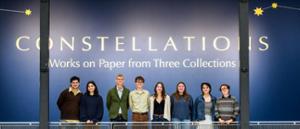
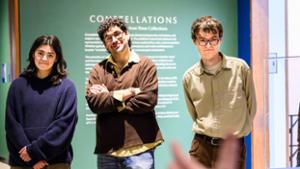
Feature photo: Ely Silverman ’26, Carter Megalli ’26, Professor Robert Knight, Will Kretz ’26, Sydney Cagnetta ’28, Catherine Hicks ’28, Lily Watts ’26 and Clair Payne ’28 pose for a photo during the opening of the exhibition, “Constellations Works on Paper From Three Different Collections” at the Munson. Photo by Nancy L. Ford.
Immersion into the Art World
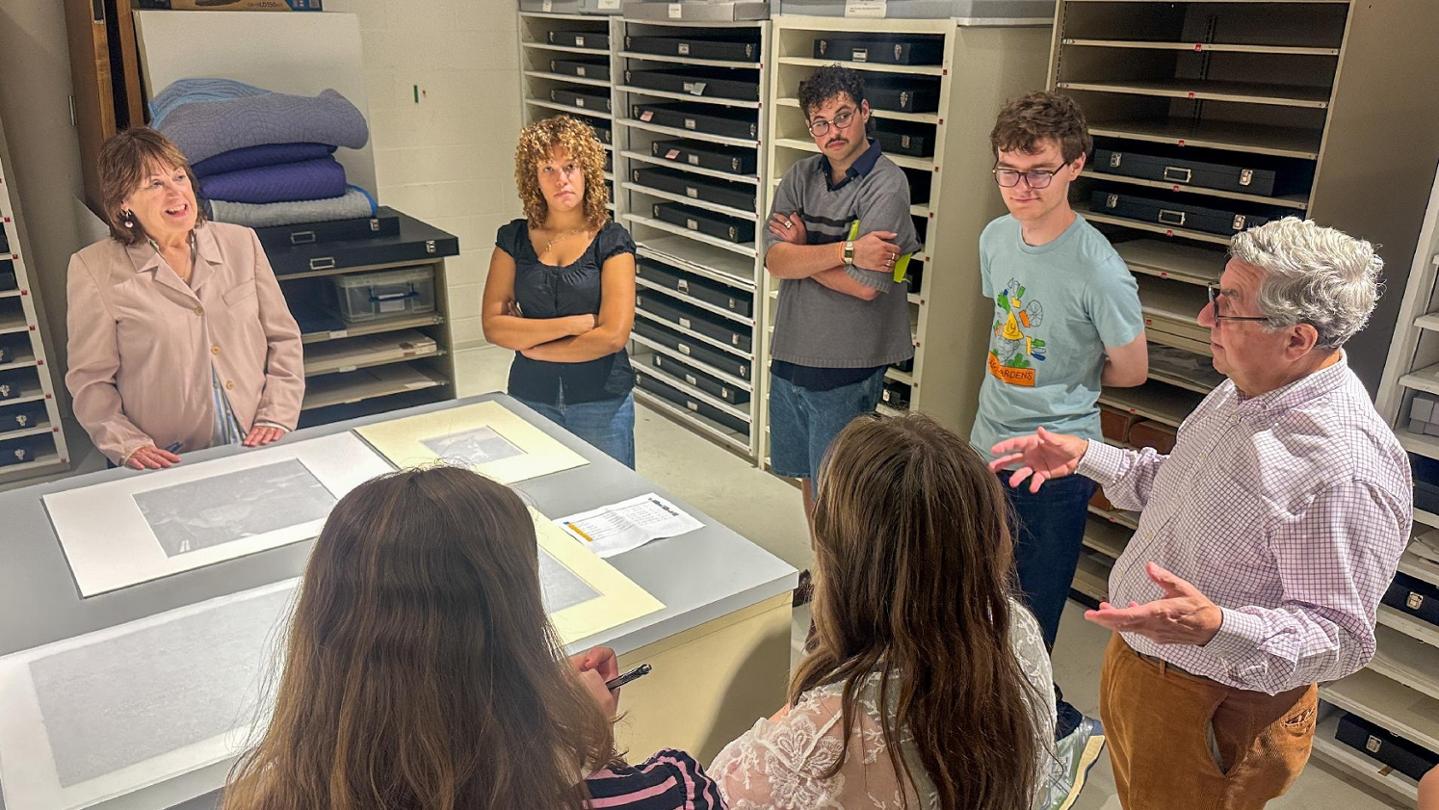
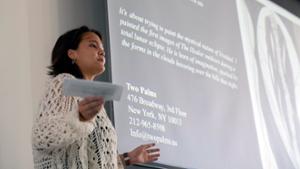
The exhibition is composed of works on paper from the Munson, Hamilton’s Wellin Museum, and Shapiro’s own collection. As part of the course, students first learned about the history of works on paper. By attending lectures, doing readings, and responding to works, they built the skillset to take the next step. On a weekend in October, they traded classroom discussions for the bustling streets of New York City.
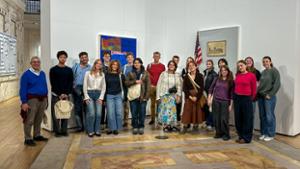
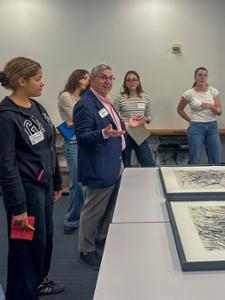
In the city, Shapiro and Knight guided students through an array of museums, galleries, and auction houses. At each of these locations, they had the opportunity to learn from Hamilton alums working in the art world. “I can’t help but be a little jealous that they get to take a class like this,” said Sophie Lewis ‘22, who works at Jack Shainman Gallery. “This gave students direct insight into the inner workings of galleries, the art market, and how an art history degree can translate into a career.”
“The trip gave me an insight into what a curator does ... it helped me network and realize that this is something I would want to do.”
The students felt similarly. “The trip gave me an insight into what a curator does,” said art history and government major Beatrice Toledo ’27. “It helped me network and realize that this is something I would want to do.” Sydney Cagnatta ’28, a physics and art major, said the course opened her eyes: “Being able to witness what goes on behind the scenes, that’s something I’ve never seen before.”
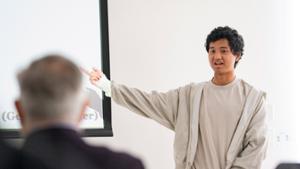
Intrinsic to the inner workings of any gallery is the acquisition process. Baked into the course is the responsibility of acquiring works for both the Munson and the Wellin. Students voted on what pieces to acquire and built the pitches for them.
“Rob and Michael encouraged us not only to prioritize which pieces we personally enjoyed, but to form opinions for the future of each museum based on two points of specific criteria: strong acquisitions either add on to the existing collection or they fill gaps missing from the collection,” Toledo said. “Everyone presented very thoughtfully, so it became suspenseful waiting to hear back from the directors.” The final acquisitions: Benny Andrews’ Just Thinkin' for the Munson and Malick Sidibe’s Photo Mariage Diane for the Wellin.
Building the Exhibition
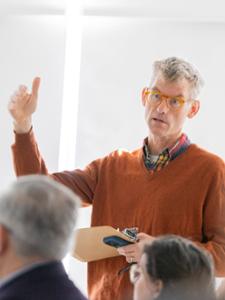
Next, they began to curate the exhibition. Students were divided into six groups: Wall Text, Graphic Design, Layout, Interactive/Children’s, Documentary Film, and A/V. In their groups, students brought the liberal arts nature of the course to life. “I believe in making things as experiential as possible,” Knight said. “It connects the skills you learn at a liberal arts school with real world practices.”
Students developed their communication skills in meetings with Munson staff and cross-group collaboration; their creative eyes in SketchUp designs of the space; their writing and research skills in the wall text and copyright permissions. “Any museum in the country would be proud to have done what they’re doing,” Shapiro said. “And, they're doing it as part of their educational growth, too.”
The course also offered pedagogical growth. “Curation is something that came to me as an interest, not as academic training,” Knight said. “So, by teaching this course with Michael, I’m also enabled to try something new.” Shapiro, who has exhaustive experience with curatorial studies, was beyond impressed with how the course unfolded. “To create something that’s fresh and new takes a lot of work, it doesn’t just happen by itself,” he said. “And yet they’re making it happen in a way that is lively and engaging. And I think they’ve exceeded their own expectations.”
“To create something that’s fresh and new takes a lot of work, it doesn’t just happen by itself ... And yet they’re making it happen in a way that is lively and engaging. And I think they’ve exceeded their own expectations.”

Curating a Community
A liberal arts education should always cultivate newness and exceed expectations. But, like Shapiro said, it doesn’t happen by itself. The success of this course wouldn’t have been possible without the community that Hamilton has curated. Not only were the contributions of alumni a core component to this course, but Hamilton’s relationships with the Wellin and Munson were core to the course’s experiential learning. And, through these experiences, current students are becoming part of what Shapiro called a “multigenerational community in the visual arts.”
The future looks bright. Scott Nussbaum ’02, deputy chairman at Phillips Auction House, put it best: “It takes a lot of time, dedication, perseverance, and little luck. But, I’m optimistic that with Rob and Michael’s encouragement, we’ll get a few more Continentals to join our ranks in the art world soon.”
The Munson exhibition and related course programming was funded through a grant from the Daniel W. Dietrich ’64 Fund for Innovation in the Arts. Additional support was provided by the NEH-funded effort to develop a curatorial studies minor at Hamilton. The exhibition, Constellations, will open at Munson on February 20, 2026.
The Exhibition Opening
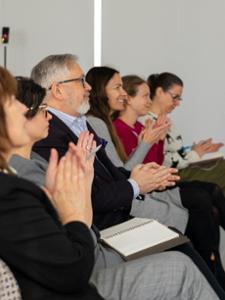
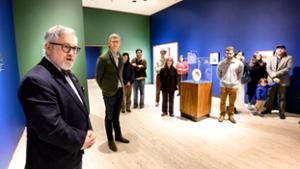
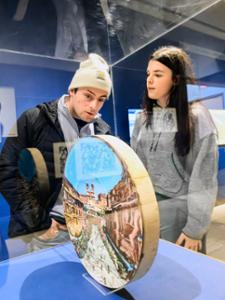
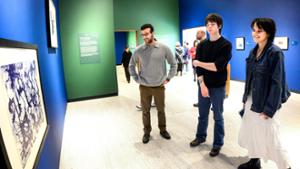
“Constellations Works on Paper From Three Different Collections” opened at the Munson in February 2026. Photos by Nancy L. Ford.
The Arts at Hamilton

Curating Curiosity Through Summer Museum Internships
In 2023, the National Endowment for the Humanities awarded Hamilton a grant for its new curatorial studies program, and this summer a handful of students had the opportunity to work behind-the-scenes as interns at regional galleries and museums. We talked with a few about their experiences.

5 Things I Learned About the Wellin
Communications and Marketing office student writer Dehler Ingham ’27 is a literature and government concentrator, but he has found plenty of reasons to visit and enjoy the Wellin Museum. Here are five of them.
