Something to Crow About
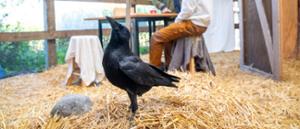
“How are you?” Asher responds ... or maybe just repeats.
One might poke fun at his seemingly limited vocabulary, but then again, Asher is a crow.
“He’s our talkative one,” Townsend said as she approached the Hamilton College Aviary, a modest research facility that opened in 2014 and is now home to three very special permanent residents; Asher, Poe, and Lenore, all American crows.
When the door opens, Asher and Poe retreat to the safety of their private enclosure in the rear of the building, while Lenore, who is housed separately from the other two, hops back and forth in excitement along the woodchip-covered floor. She pecks at the glass door separating her enclosure from the area where students are carefully preparing nutritious meals and treats for their feathered research subjects.
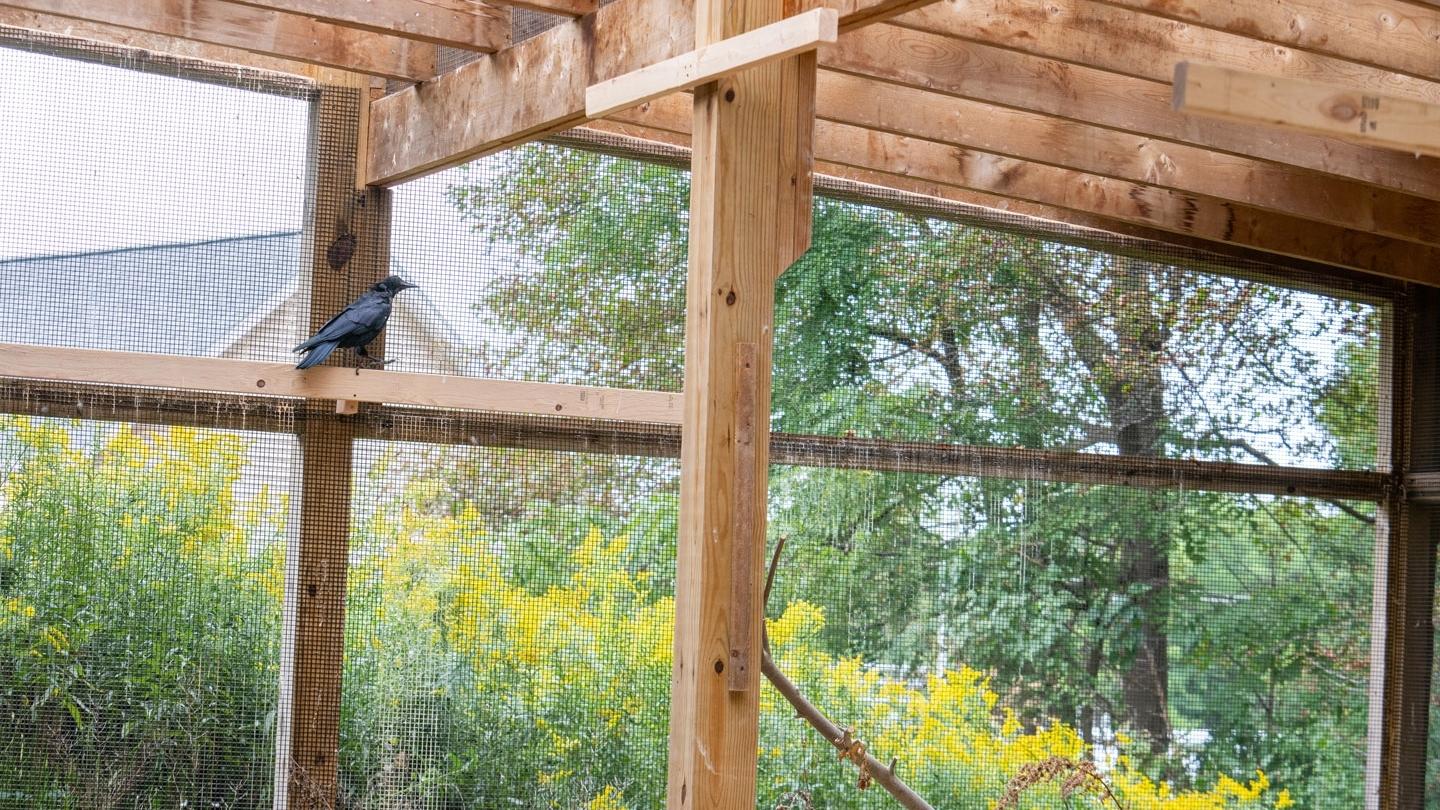
Lenore cocks her head to the side curiously watching each visitor as they file into her domain — a large indoor and fenced-in outdoor aviary with several wooden perches and toys.
She caws loudly, looking from person to person for some clue of who might be holding the snacks. Lenore knows someone always has snacks.
Since Hamilton’s Aviary opened in 2014, more than 100 students have conducted research at the facility as part of Townsend’s courses and summer research projects. The aviary has also evolved over time.
“It originally housed starlings,” said Townsend, noting that European starlings have become one of the nation’s most widespread and abundant invasive bird species after being imported from Europe by folks seeking to bring Shakespeare’s songbirds to America in the late 1800s.
And in his ear I’ll hollo “Mortimer.”
Nay, I’ll have a starling shall be taught to speak
Nothing but “Mortimer,” and give it him
To keep his anger still in motion.
It wasn’t until the arrival of Asher and Poe in 2018 that the aviary became dedicated to crows. About four years later, another crow hatchling, Lenore, joined the ranks.
Though she’s small and has a permanent wing injury that hinders her ability to fly long distances, Lenore has become Hamilton’s star pupil amongst the feathered cohort. Unlike Asher and Poe, a bonded duo who are attached to each other and both rather vocal but less inclined to interact with humans, Lenore has an ever-present desire to interact with people whenever possible, stealing the hearts of the students who tend to her daily care with antics that will instantly remind parents of a difficult toddler — sassy and precocious.

Andrea Townsend
Associate Professor of Biology
Faculty Bio
Townsend said Lenore isn’t releasable because of being hand raised as a hatchling. The star aviary resident prefers the company of her student handlers and Townsend to that of Asher and Poe, with whom Lenore has been known to scuffle if left unsupervised.
“So far, Lenore actually doesn’t seem to like other crows. She prefers the company of people,” Townsend said, noting that there are a lot of variations in crow personalities.
While there’s no plan for the aviary to acquire new birds at this time, Townsend said that when they do, it will only be for other non-releasable rescue crows that can integrate well with the existing residents.
Care and Feeding
Because Lenore, Asher, and Poe are permanent residents of the aviary, they are cared for by student volunteers from Townsend’s lab and classes, supported by Hamilton’s full-time animal care staff. The students and staff take turns caring for the crows and spend time interacting with them, ensuring they have clean water, fresh food, and ample play time.
“A typical feeding will include some dry cat food, egg yolk, chicken and beef, peanuts, peas, corn, blueberries, apples, tomatoes, and pretty much anything left over from my husband’s organic farm,” Townsend said. “Treat foods are some meal worms, and Cheez-Its for very special occasions.”
The Crow Lab
Townsend started working with crows in 2005. She says American Crows make surprisingly good research subjects, both because they are omnipresent across North America and also because there’s a lot that we still don’t know about them. They’re also very social and tuned in to people, which can make them fun to work with.
“I was interested in them because they’re very social. They live in family groups of up to 14 birds at a time, and the young can sometimes stay home for up to seven years,” Townsend said during an interview in the aviary. A few minutes later, Lenore hopped up next to Townsend, seated on a hay bale, to steal an empty eyeglass case from her pocket.
When West Nile Virus emerged as a threat to birds in the early 2000s, Townsend said she shifted the focus of her research to better understand how disease affects social behavior in groups, and now she is working to learn more about how disease in birds can affect their cognition.
“I think it’s almost inevitable that someone who works with crows gets interested in their cognition. The crows in the aviary are an amazing opportunity for students to closely observe birds who don’t mind being observed and to develop tests to look at their cognitive ability,” she said.
“I think it’s almost inevitable that someone who works with crows gets interested in their cognition. The crows in the aviary are an amazing opportunity for students to closely observe birds who don’t mind being observed and to develop tests to look at their cognitive ability.”
Summer Research
“One aspect of keeping crows in captivity is that they’re social, so you need to spend a lot of time with them,” Townsend said. “You have to hang out with them and provide them with new enrichment, new toys, new engagement.”
An activity that simply looks like a good time to a crow can actually be an important tool for researchers in their quest to learn more about the species.
“This summer, we started turning some of this enrichment into hypothesis testing, using that play time to see what the crows could really do,” Townsend said.
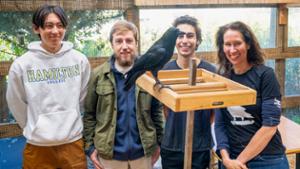
Five students spent the summer doing just that. Demetri Passalaris ’29, Abby Rich ’28, Spencer Stephens ’28, Simon Shin ’29, and Zihui “Luna” Wang ’27 joined Townsend’s research lab to see what they could learn from Hamilton’s sharpest bird brains.
“I was surprised with how friendly crows are ... It's interesting to see how wildlife is, you know, isn't always so wild.”
Wang’s research focused on crow migration (yes, some crows really do migrate), while Rich, Stephens, and Shin embarked on research to better understand the executive functions and cognitive performance of Lenore across four core testing paradigms.
Just how smart is Lenore in comparison to humans? Can she use tools? Can she track hidden objects? Does she understand delayed gratification? (The answer to that last question is a resounding, “No.”)
“I was surprised with how friendly crows are,” said Passalaris. “Even Asher and Poe are particularly friendly. They like to come and say hello, "How are you?" and they want to talk, so ... It's interesting to see how wildlife is, you know, isn’t always so wild.”
The students practiced a method called “model rival,” in which they “train” each other with the various cognitive tests in front of Lenore before giving her a chance to take part in their game.
“Lenore watches and gets jealous, and that makes her more willing to engage in the research,” Townsend said.
Wang’s research focused on how migration might impact disease resistance in crows. She and her collaborators found that crows traveling from the far north had higher rates of bacterial infections and fewer disease-fighting white blood cells. This suggests that long migratory trips may weaken a bird's body defenses, raising its risk of getting sick. Still, infection levels did not directly match white blood cell counts, so scientists need further testing to learn more about this phenomenon.
What can Lenore do?
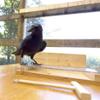
Can Lenore use tools?
The Test
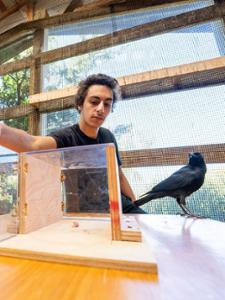
Students positioned food out of direct reach in a transparent box outfitted with a rake-like apparatus; Lenore was required to pull the rake straight or at an angle across multiple difficulty levels to bring the food within reach.
The Findings
Yes. Lenore achieved an overall success rate of 39% across trials on the rake-pull test across difficulty levels. Students found that Lenore is capable of learning tool-use skills, similar to jays and cockatiels, and her ability to utilize a specialized rake to pull food out of the container is comparable to the executive function of a 16-month-old human infant.
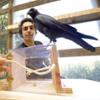
Can Lenore be patient and wait for the big reward?
The Test
Over six days of testing, Lenore observed a transparent box where a sequence of progressively improving treats were added over time. By opening a door to the side of the apparatus, Lenore could take a treat, but doing so also immediately ended the trial sequence, and as a result, Lenore would not get the most coveted of treats (reserved only for patient birds).
The Findings
Not at all. Unlike wild-caught New Caledonian and carrion crows, Lenore was unable to pass the delayed gratification test as she never waited past the first (and least desirable) treat offering. As soon as a student researcher put a treat into the box, Lenore opened it and gobbled it up for immediate gratification. Student researchers hypothesized that this action may be affected by her being hand raised and having limited conspecific interactions. Students conducted this test with Lenore 18 times. She failed 18 times.
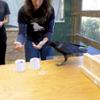
Can Lenore track objects that are hidden in full view?
The Test
Placed food under cups and shifted their locations in full view of Lenore before allowing her to uncover the cups to retrieve the treat.
The Findings
Yes. Lenore achieved a 100% success rate in locating hidden rewards after two days of testing. Like carrion crows and rooks, Lenore demonstrates Piagetian Stage 5 object permanence by successfully tracking items that are visibly hidden. American crows are widely known to use object permanence in food caching, suggesting that this may be more than an adaptive skill driven solely by survival in the wild, as Lenore engages in this behavior even in captivity.
With training, Lenore progressed from the object permanence abilities comparable to an 8-month old human to those of a year-old human by eliminating the A-not-B errors she initially made.
Does Lenore understand human words for colors?
The Test
Students applied a model/rival technique where Lenore received a food reward for selecting a cup corresponding to a spoken color term (e.g., yellow/red).
The Findings
Not really. Lenore chose the correct color cup in 57.1% of trials (36 out of 63), which was not statistically different from random chance. Unlike parrots, Lenore showed no significant capacity to map spoken words to color concepts, despite her visual color recognition capabilities.
American Crow (Corvus Brachyrhynchos) FAQ
Crows in the wild have an average lifespan of about 7 to 8 years. In captivity, crows have been known to live longer than 60 years.
Yes, crows face natural predation primarily from hawks and great horned owls. To defend their territory, crows will congregate in groups to mob, chase, and harass these predators until they leave the area.
Crows are omnivores. At the Hamilton Aviary, Townsend’s team of students often feeds crows a wide mixture of fresh fruits, vegetables, eggs, and meat.
Yes. Through satellite and Bluetooth tracking tags, researchers have mapped the movement of regional crow populations. Many crows that overwinter near the Hamilton College campus migrate along the St. Lawrence River to breed in Montreal and Quebec. They migrate back to rejoin resident populations to form massive wintering flocks of around 8,000 birds in places like Utica, New York.
Crows may be more resilient compared to species with narrow ranges or high habitat specificity. Their broad geographic adaptability and flexible migratory habits may help shield them from some climate pressures. That said, Ebird data suggests that American crow populations have declined by more than 10% between 2012-2022.
A primary area of research centers on crow genetics and social structures, Townsend said, specifically the high incidence of inbreeding, such as mothers mating with adult sons or uncles with nieces. While inbreeding is rare in most other species and causes observable health and disease vulnerabilities in crows, researchers hypothesize that living closely with kin may provide evolutionary advantages, such as enhanced cooperation in foraging and collective predator defense.
Researchers are also working to understand what will happen to crow populations in regard to emerging infectious diseases, like West Nile virus and avian influenza. Early data suggests that crows are highly susceptible to both of these diseases. How will crows respond to these new diseases, both behaviorally and genetically? The extent to which they might evolve to be resistant to these new diseases, and the long-term effects of these and other diseases on their populations, are active areas of research.
Research & Discovery at Hamilton
Through independent projects, research with faculty members, summer internships, and the Senior Fellowship Program, Hamilton provides opportunities for students to engage in significant research at the undergraduate level.
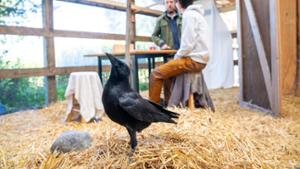
More than 100 students have conducted research at the Hamilton Aviary since it first opened in 2014. The Aviary has also evolved over time and is now home to three permanent residents; American Crows Asher, Poe, and Lenore.

Hamilton Students and Faculty Explore What AI Can — and Can’t — Do
From genetic research and ethical decision-making to communication and political misinformation, Hamilton students and faculty are exploring the growing role of artificial intelligence in society. Their research examines both the potential of AI to solve complex problems and the challenges that arise when the technology falls short.
