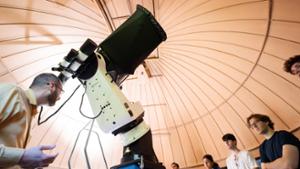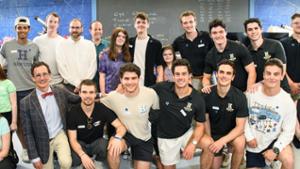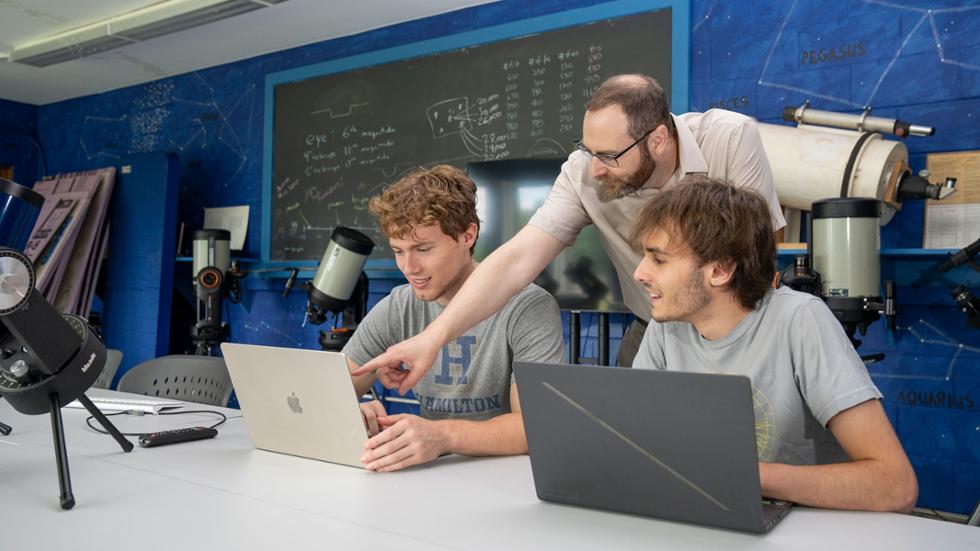
Their work is part of NASA’s MIT-led TESS Follow-up Observing Program, which confirms potential planets first identified by the Transiting Exoplanet Survey Satellite (TESS). Rather than searching for plants directly, the team monitors distant stars for subtle changes in brightness.
“We are planet hunters, looking for planets that orbit around distant stars,” Lark said. “As a planet passes in front of its star, it will cause a dip in the amount of light we see coming from that star, like a mini-eclipse.”
Those tiny dips, measured over several hours, can reveal information about a planet’s size and orbit length. Confirmed planets may eventually be studied by larger observatories, including the James Webb Space Telescope, which can search their atmospheres for potential signs of life.
“Our observatory is a step on the rung toward potential confirmation of life on other planets,” Lark said.
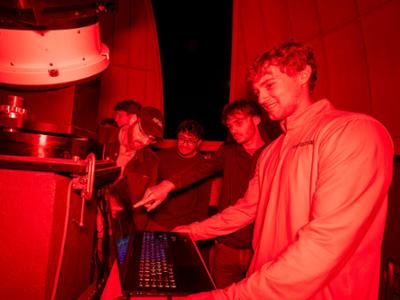
The work requires both patience and unusual hours, with the students often staying from dusk to dawn at the observatory collecting data before analyzing thousands of images during the day.
For Raabe, it’s an opportunity to combine a longtime interest in astronomy and the chance to contribute to real scientific discovery. “I’ve been fascinated with astronomy and space exploration for a long time outside of school,” he said. “When I heard about this amazing exoplanet search that [Professor Lark’s] been a part of, I immediately wanted to join the team.”
“This is unique to anything I have done in the classroom based on how much is up to us...”
Beyond collecting observations, the team also maintains equipment and works to improve the observatory’s technology.
Fitzgerald shared that one of the most rewarding parts of the project has been the responsibility he and Raabe were given throughout the research project. “This is unique to anything I have done in the classroom based on how much is up to us,” he said. “Even what target star we looked at we chose with our professor.”
Learning specialized astronomy software and quickly mastering new techniques proved challenging, but for Fitzgerald, the experience sparked a deeper interest in the field. “This project has given me great interest in astronomy and the possibilities in the field after college,” he said.
Beyond the research itself, the observatory also serves the broader community. Throughout the summer, the team has hosted public stargazing events for local high schools as well as the Hamilton community, sharing both the night sky and the science behind their work.
“Connecting the public to our research and work in this way is a very important and meaningful aspect for me,” Raabe said.
The project has already produced promising results. Earlier this summer, the team submitted observations of a potential “hot Jupiter” –– a Jupiter-sized planet orbiting its star every six days. If the candidate is confirmed, the data could become part of a published scientific paper with Lark and his students credited among the contributors.
For Lark, that’s part of what makes the research so exciting.
“We are on the forefront of discovery on a new frontier of astronomy,” he said. “This science didn’t exist 30 years ago. Only recently have we been able to start to discover planets around other stars, and they are everywhere. To date, thousands of planets have been discovered, but millions more are out there waiting for us to find them.”
Posted July 30, 2026