Searching for Magic
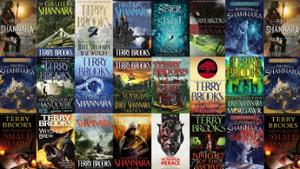
“I read that book and I was mesmerized,” he remembers now. “It was magical; it was otherworldly. I wanted to write something with that kind of power.”
The book he eventually ended up writing, The Sword of Shannara, changed the world of fantasy writing when it became the first in its genre to make The New York Times bestseller list upon its 1977 release, eventually selling millions of copies.

Terry Brooks ’66
Fantasy Author, “Shannara” and “Magic Kingdom of Landover” series; novel adaptations of the films Hook and Star Wars: Episode I
Brooks is as responsible as anyone for turning fantasy into the popular genre it is today, following up that first book with another 50 over a five-decade career before his retirement in 2024 at age 80. His works include 23 bestsellers, many set in the world of Shannara, a broken version of our own earth, in which generations of humans, druids, and elves wield magic to keep the forces of darkness at bay.
In exploring those themes, Brooks was influenced as much by modern American writer William Faulkner — whom he discovered in classes at Hamilton, eventually writing his thesis on him — as by Tolkien or other fantasy or science fiction authors.
“Tolkien was the driver for the setting of the story I wanted to tell, but Faulkner was the driver for the way I wanted the story to feel,” Brooks says, citing as a prime influence Faulkner’s masterful short story “The Bear,” about generations of a family struggling with issues around wilderness, civilization, race, and heritage in the American South.
“It’s so powerful to see the evolution of self during the course of the story, following generations of families and relationships, and all of the things we live with in the real world,” he says. “But I wanted it to be stronger than real life by adding elements of magic.”
The theme of magic as a force for both hope and corruption runs like a current through all of the Shannara books, creating a larger-than-life setting for storytelling long before Harry Potter entered the world, and becoming an obsession for Brooks throughout his long career. “We are all looking for magical things to happen in our relationships and experiences,” he says, “and for the most part they do in some way if we look hard enough.”
Brooks grew up in Illinois as a voracious reader of Arthurian legends and adventure stories of the likes of the Hardy Boys and Tarzan. He came to Hamilton to “escape the Midwest,” he says, continuing his habit of voracious reading, even if by his admission, “I never was a stellar student. But I sure learned a lot about being a writer. I never got a chance to thank all those teachers for the interest they generated in me for books and writing.”
“I never was a stellar student. But I sure learned a lot about being a writer.”
While Brooks always aspired to be a writer, he had no idea how to go about it. At the urging of his parents, he enrolled in law school more to escape going to Vietnam than for any interest in the field. He applied to Washington and Lee in Virginia, finding out only after acceptance that it, too, was an all-male school.
“How could I make the same mistake twice?” he laughs. Crushed with the weight of the law-school curriculum, he turned to writing to escape, working on the novel that became The Sword of Shannara. It tells the story of half-elven farm boy Shea Ohmsford, who is visited by the mysterious druid Allanon and told he is the last surviving progeny of the elven House of Shannara. As such, he is the only one who can wield the titular sword to defeat the evil Warlock Lord who is amassing his armies of trolls and gnomes to take over the Four Lands.
The strength of his storytelling caught the attention of science fiction editor Lester Del Rey, who published it as one of the first books of his new imprint Del Rey Books, which became synonymous with modern fantasy. Early critics blasted the book as too derivative of Tolkien, but readers lapped it up, buying 125,000 copies in its first year alone.
“I got ripped apart by reviewers who said this was a Tolkien rip-off,” Brooks says. “They took me apart at the seams in every newspaper in the country.” While he doesn’t think the criticism was warranted necessarily, Brooks admits he was naïve as a young writer. “The first book was an experiment. I didn’t know what I was doing in the beginning,” he says.
Del Rey reassured him everything would be okay. “He said, ‘Don’t worry, it will all work out in your favor,” Brooks recalls. “People are going to love these books.’ And he was right. I don’t hear anything about Tolkien these days.”
He became more serious about writing, challenging himself to become a better writer. “The competition was always with myself — how can I write a better book? How can I make this book more interesting? How can I reach more people?” He’d already improved significantly with his next book, The Elfstones of Shannara, which follows Shea’s son Wil Ohmsford and remains arguably his most beloved novel, and The Wishsong of Shannara about Wil’s children Brin and Jair, who inherit their family’s magical powers.
After finishing the trilogy, Brooks decided he wanted to write a different story. Del Rey coyly told him he had an idea, but he wasn’t sure Brooks was right for it — which of course made him more eager for the challenge. “He led me on, but finally he told me his idea”: a middle-aged man, unhappy with his life, who sees an ad for a magic kingdom in a catalog. Brooks dove into the tale, publishing it as Magic Kingdom for Sale — Sold! in 1986, telling a more traditional story of fairies, wizards, and dragons with a more humorous tone. The success of that book allowed him to quit the law and write full time; at the same time, he met his future wife, Judine, and settled in the Pacific Northwest.
Brooks followed that up with several more Magic Kingdom books, as well as a series of darker novels known as the Word and the Void trilogy, an urban fantasy story about demons menacing an Illinois town. “It wasn’t real after a while,” he says of his meteoric success, with hit after hit throughout the 1980s and ’90s. Even as other fantasy writers followed in the path he’d blazed, he maintained his humility. After going to a book signing where a publisher charged for the author’s signature, he vowed never to charge for anything he did for a reader. Even now, he maintains a reputation in the industry as a warm and generous author at his many appearances at conferences and signings.
“I feel if you are lucky enough to be where I am — and I feel extraordinarily lucky — then you owe it to people to be decent to them,” he says.
On his many book tours, Brooks has often passed through Upstate New York, stopping by Hamilton when he can, including a talk he gave at his alma mater in 1998. He marveled at all of the changes, including co-education, since 1978. “When I went back the last time and saw all those women walking around!” he says, shaking his head.
Along the way, he’s had some missteps, including accepting an opportunity to write the novelization for the Stephen Spielberg movie Hook about Peter Pan’s nemesis. “It was one of the big mistakes of my life,” he laments. Spielberg wouldn’t talk to him — and neither would anyone else associated with the film. Nor was he invited to set, leaving him to largely write the book from his own imagination.
That experience made him reluctant to accept another commission in the late 1990s, when George Lucas approached him to write a novelization for a new Star Wars movie. “I could turn it down and walk away, but if my kids ever found out, they’d never let me live it down,” he recalls. Thankfully, the experience was completely different, including three days spent with Lucas at Skywalker Ranch viewing storyboards and hearing the whole background of the story. In writing the book for The Phantom Menace, Brooks added his own touches, which Lucas accepted into the lore. The book hit #1 on The New York Times bestseller list for four weeks in 1999 and was lauded by fans in helping flesh out some lackluster aspects of the film.
More than anything in his career, Brooks returned again and again to his first love, Shannara. He wrote prequels and sequels to the original trilogy, tracing not only the Ohmsford family over the years, but also the history of the druids and other families. As he explored the expanded universe, the books became darker, as he revealed that the world was actually our own, set 3,000 years after a nuclear holocaust. Magic becomes more dangerous as well, just as often a source of temptation and corruption as one of redemption.
“I wanted things to be dangerous for the characters not only because of what’s out there in the great beyond, but also from what’s within themselves,” Brooks explains. “Everyone says, ‘Wouldn’t it be wonderful to have magic?’ And well, yes — but also, maybe not.” The same power that could heal the world, he surmises, could also be used to hurt. “With magic, it seems to me, you would always be struggling with how to control something more powerful than you. It was more interesting to see people struggling with difficulties than seeing them succeed.”
“I wanted things to be dangerous for the characters not only because of what’s out there in the great beyond, but also from what’s within themselves. Everyone says, ‘Wouldn’t it be wonderful to have magic?’ And well, yes — but also, maybe not.”
Despite such difficulties, however, Brooks’ novels are prized by fans for always containing a kernel of hope no matter how dark they get. That positive outlook, he says, is shaped by his own. “I’m a pretty hopeful guy and have a pretty positive attitude about life. That’s why I’m still smiling at 82.”
Brooks insists he never thought of himself as old until he turned 80 two years ago and felt his brain wasn’t quite as sharp as it once was. When his editor told him a new book wasn’t up to snuff, he decided it was time to quit. “She said, ‘You can’t quit, you’ve just started a new series.’ I said, ‘Yeah, I’m done.’ I think I had just burned myself out. I had worked hard for 50 years, and I think that’s enough for God’s sake.”
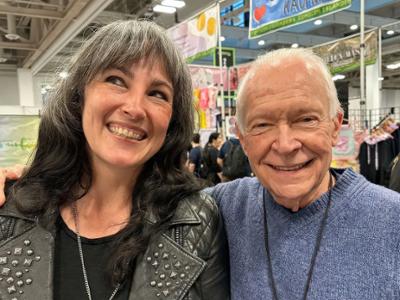
To maintain the Shannara legacy, he tapped a successor, Delilah Dawson, a virtuoso genre author of fantasy, sci-fi, young adult, and romance, who is set to come out with the second book in Brooks’ The First Druids of Shannara series in August. In retirement, he has turned back to his first love, reading, surprising his wife by staying true to his word not to write another book. “I have hours and hours every day to just read books,” he says excitedly. His interests span genres, though these days, he’s been enjoying the detective fiction of writers Jo Nesbø, William Kent Krueger, and John Connolly.
Brooks still finds time to go to fantasy conventions, where he’s been pleased to see the new gender and ethnic diversity in the fantasy genre. “When I started out, authors were almost all male, with very few exceptions,” he says. “Now, the dominating force are young female writers. Some of them are extraordinarily good — they make me jealous.”
When he considers his own legacy as one of the founders of the modern fantasy novel, Brooks remains modest. Asked what he hopes readers find when they pick up one of his books, he says, “I hope they’ll find good storytelling — that they’ll be engaged in the story of the characters, and it will carry them away and make them think about the world.” He pauses, considering his own lifetime of writing and reading. “I always want them to have the same experience I have with some of the writers I’m reading now, and say, ‘Wow, did he or she tell one hell of a story.’”
Michael Blanding is a journalist and author of several books. His work has appeared in The New York Times, Smithsonian, The Nation, and WIRED, among other publications. He notes, “I had a great time talking with Terry! Wish I could have told my 13-year-old self I’d have that opportunity in the future.”
More from the Magazine
A celebration erupted moments after the overtime goal sailed into the net. Hamilton’s first national men’s hockey championship didn’t come from a breakthrough strategy or a singular star, but from something less tangible that has been a long time in the making.

What makes a strong admission essay? One that’s well written, of course, but also thoughtful and authentic. This is your chance to show us who you are beyond grades, test scores, and lists of activities. Your essay provides insight into your character, perspective, and motivations. The following essays are examples of just a few terrific admission essays written by members of Hamilton’s Class of 2030. We hope they provide you with inspiration.

In this excerpt from a column originally published in Hamilton magazine, Vice President for Enrollment Management and Dean of Admission John McLaughlin offers prospective students insight into what makes an exceptional college essay.
