Griffiss Institute Releases Findings From Levitt Center Student Economic Research

This summer, Levitt Center student researchers Luke Hanson ’26, Delaney Patterson ’26, Samuel Low ’28, and Ton Somnug ’27 joined forces with GI’s CEO and Hamilton alumna Heather Hage ’02 to investigate the holistic impact of federal spending on the local economy. The Griffiss Institute recently released the findings from the Levitt Center study. (Nov. 2025)
Using data from GI, the students modeled how injecting money into the economy through GI’s various programs can have ripple effects. One example of a ripple effect is employees spending part of their salaries at local businesses. The students can then use this modelling to determine the efficiency of spending federal funds on nonprofits like GI. Working with GI’s data has also granted the students a taste of what real-world economists do in their everyday jobs.
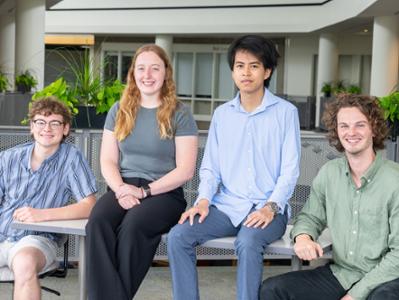
“Comparing my experience with Econometrics, in class I just had to download the data set and put it in the model,” Somnug said. “It’s a lot more hands-on here. We get these big spreadsheets which aren’t as clean and we need to figure out what to filter, what to keep, what to use as the metrics for our analysis.”
Hanson added, “We’re using the same software that real consultants and research agencies use, which is a great opportunity to do something more professional in a college setting.”
“We’re using the same software that real consultants and research agencies use, which is a great opportunity to do something more professional in a college setting.”
Through their research, the students have also become more connected with the Mohawk Valley beyond the Hill. Part of their project included speaking with community members and local businesses about their sentiments regarding federal funds.
“Working on this project, I’ve gotten a greater appreciation for how much this area has gone through and how much it struggled,” Low said. “This work has been a source of pride for me since we can potentially recommend to organizations something that helps uplift the area.”
About the Griffiss Institute
Griffiss Institute (GI) is a STEM Talent and Technology Accelerator for the United States Department of Defense. They train workers and promote research and development in critical fields such as cybersecurity, drone technology, and quantum computing.
Patterson added, “People have been burned once. They don’t want to be burned again. We need to communicate to people that there are positive economic effects happening from [GI] and that this isn’t a repeat of what happened 30 years ago.”
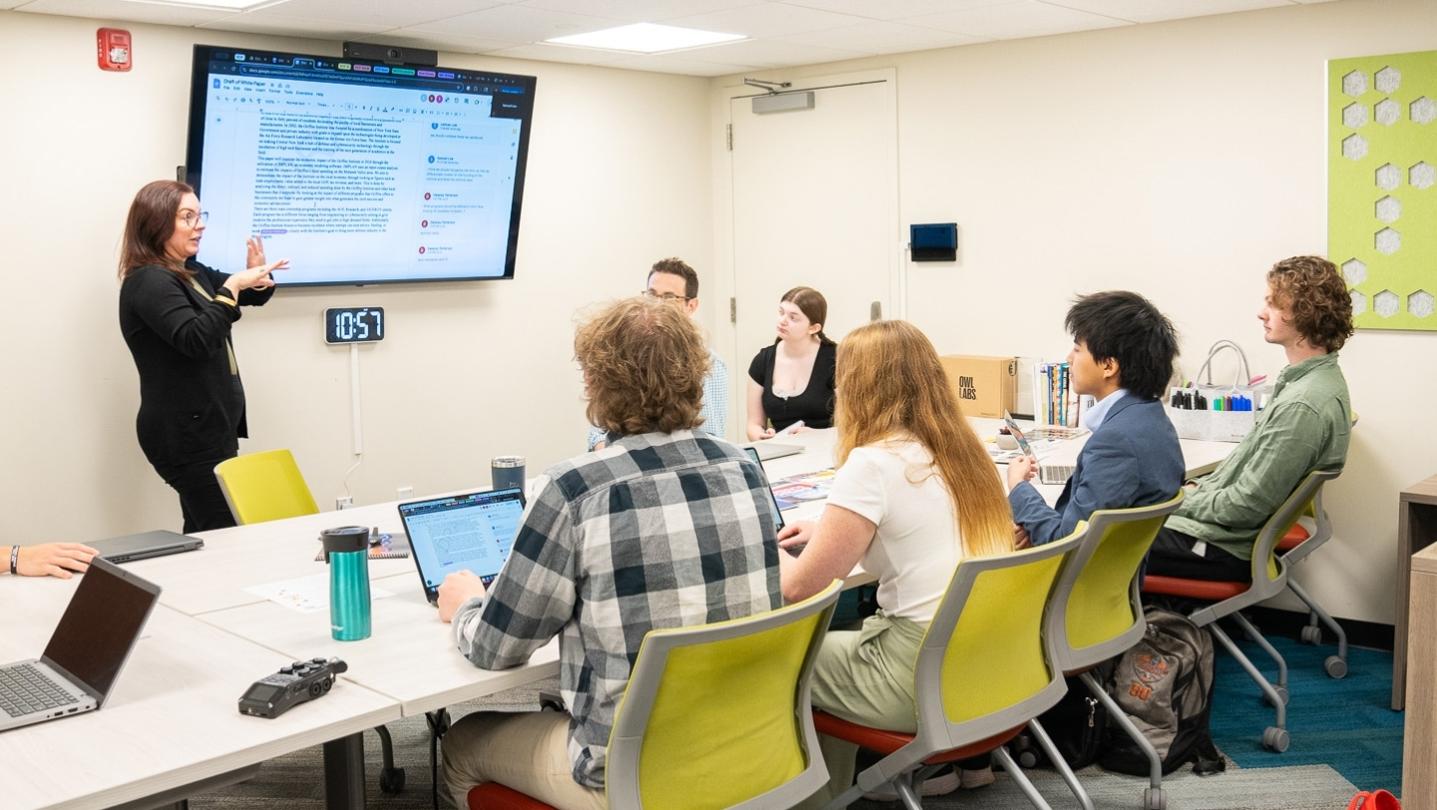
The students also gained a mentor figure in Hage, whose direction helped the team navigate challenges in their research. During their weekly meetings, Hage encouraged the students to share their thoughts and supported their decision-making, while also offering her own professional experience and advice to refine the scope and presentation of the project.
Hage said, “I have done my best to show up for our Hamilton team, whatever and whenever they ask. When they call, I answer. When they need more data, I go get it. When they have questions, I do my best to explain; but truly, I learned as much from them as they did from me.”
Patterson commended her leadership, saying, “She’s been so great in guiding our project and teaching us about how nonprofits function.”
As a Hamilton alumna and a local from Utica, Hage saw this project as a way to give back to the college that “introduced [her] to ideas, people, and resources [she] did not know existed.”
She explained, “Nearly 25 years later, bridging the Hamilton experience to real social and economic issues in our community affords the opportunity to channel the frustration and confusion of a 20-year-old me into meaningful, practical, scholarly, and transformational thinking, knowledge, and work products.”
Through this collaborative research, Hage and the student researchers hope to illustrate the value of investing in technological development in the Mohawk Valley and the crucial role federal funding plays in continued advancements and economic output.
“It’s important for people, especially in government, to know the ramifications of cutting budgets,” Hanson said. “One of the main end goals of this project is sharing a memo or brief with representatives at the state and federal level to inform them that if they make shifts away from this, you’re going to lose jobs, economic output, and tax revenue.”
Hage remarked, “Understanding the current economic and social impact of the GI’s work in our home region is crucial to our future. The findings of this project will empower us and our stakeholders to understand, to communicate, and to continue to strengthen our impact as a nonprofit organization sworn in service to our country and community.”
Student Research
Research & Discovery
Hamilton students collaborate with professors on original research. Often their work results in articles published in peer-reviewed journals or in presentations at national conferences.

From Ethiopia to Clinton and Back: Ruhama Lambert’s ’27 Senior Fellowship
When Ruhama "Ru" Lambert ’27 first arrived on campus, trotting the globe while pursuing an independent fellowship wasn’t on her radar.

Beck Joins $20M Federal Research Initiative for Scientific Drilling Platform
The National Science Foundation has awarded $20M to a team of scientists, including Hamilton Associate Professor of Geosciences Catherine Beck, to develop a modular drilling platform for research on large lakes and in nearshore marine settings. The system will allow scientists to collect samples at sites that existing systems cannot reach.
