Lydia DeTraglia '28
Major: Chemistry
Hometown: Clinton, N.Y.
Aksel Reid '27
Majors: Biochemistry/Molecular Biology and Mathematics
Hometown: Minneapolis, Minn.
Lucas Constantine '27
Major: Biochemistry
Hometown: Los Angeles, Calif.
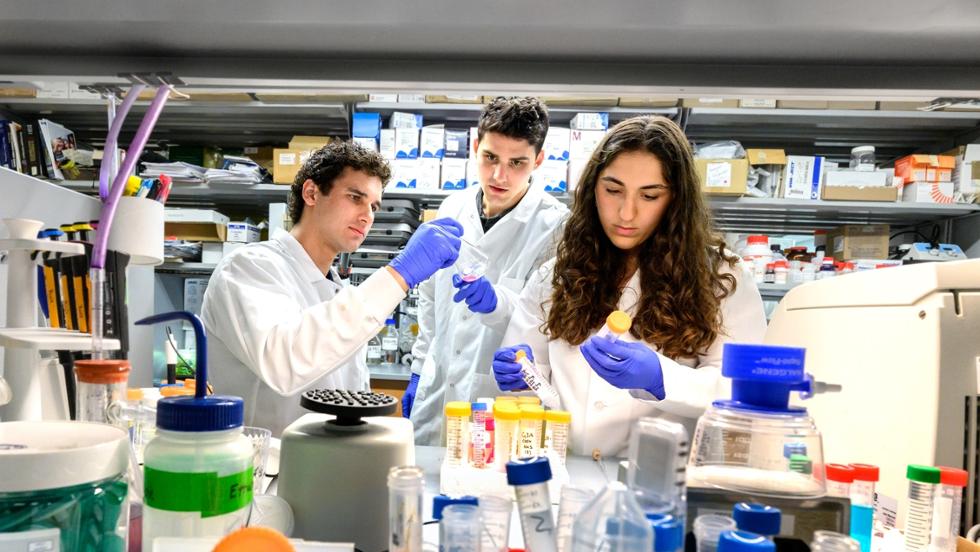
Working in the McCarthy Lab under the mentorship of principal investigator Dr. Khanh Ha, DeTraglia and Reid spend 40 to 50 hours each week designing, synthesizing, and analyzing compounds alongside scientists. Beyond the lab, they participate in weekly journal clubs, discuss scientific literature, and present their work. Although their projects differ, both students are using chemistry to address real-world medical challenges.
DeTraglia is developing fluorescent dyes that allow scientists to visualize biological systems in real time, including blood clots and the enzymes that break them down.
“I have really enjoyed seeing the intersection of my knowledge of organic synthesis, biochemistry, and nanoparticle applications with the research I'm doing,” she said.
Reid’s research also focuses on compounds with potential biomedical applications. One project involves a peptide related to a potential treatment for rare kidney disease, while another aims to develop a fluorescent probe that could help detect transplant rejection.
For DeTraglia, one of the biggest lessons has been learning to embrace setbacks.
“Usually, if an experiment doesn’t work the first time, even the smallest adjustments can change the outcome on the next run,” she said. “I’ve learned it’s important … to not assume failure as soon as something doesn’t work out.”
“I’ve learned it’s important … to not assume failure as soon as something doesn’t work out.”
For Reid, the experience has strengthened his confidence in sharing and explaining his work.
“Presenting hasn’t been a strong suit of mine in the past, so this internship has been very beneficial for me in learning how to professionally convey my findings on posters and be able to talk about them to other experts in the field,” he said.
The opportunity has also introduced the students to the broader scientific community. DeTraglia has presented her research at conferences hosted by Harvard University and New York University, introducing her to researchers who inspire her.
“Talking with them and seeing their work made me extremely excited for a future in research,” she said.
Both Reid and DeTraglia credit Hamilton’s chemistry curriculum for preparing them for the advanced work they are now conducting. Courses in organic chemistry, biochemistry, and laboratory techniques provided a strong foundation while showing how classroom concepts translate to scientific research.
They are not the first Hamilton students to participate in this fellowship with MMRI. Two of Hamilton’s last three Fillius Drown Prize Scholarship winners, Joe Kubofcik ’25 and Lucas Constantine ’27, also conducted research at the Institute, reflecting the strength of MMRI’s mentorship and research opportunities.
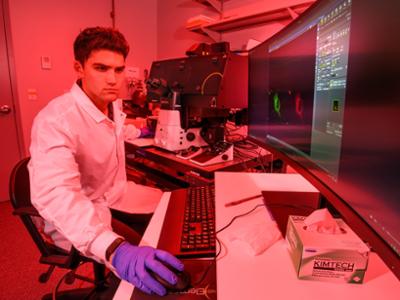
Constantine completed the MMRI Summer Fellowship in 2025 and returned this year as an intern supported by an undergraduate research grant from the American Chemical Society. Before joining, he learned about the work of former Hamilton students Kubofcik, Dasomie Kim ’25, and Jeffrey Cheng ’25 during his interview with Dr. Ha. Their projects introduced Constantine to the research and mentorship available in the McCarthy Lab.
His current research focuses on developing fluorescent compounds with potential applications in image-guided surgery and targeted drug delivery. After spending two summers at MMRI, Constantine says the experience has shaped both his career aspirations and his confidence as a researcher.
“MMRI has grown my love for research, science, and medicine and inspired me to pursue a career focused on both helping patients and finding innovative scientific solutions to evaluate and treat the world’s most deadly diseases,” he said.
Constantine credits Dr. Ha, Dr. Jason McCarthy, and research assistant Maddelyn Hoehn with helping him develop as both a scientist and future physician.
“Through [their] mentorship … I have grown from a student with an interest in medical school to a competent undergraduate researcher with the aspiration of advancing medical research while pursuing a career as a physician,” Constantine said.
Posted August 10, 2026