The Life and Legacy of Justus Doolittle
More than a Missionary
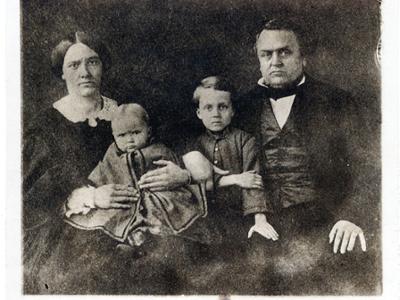
Born in 1824 in Rutland, N.Y., Doolittle traveled with his family first to western New York and then Indiana before returning to New York at age 17 to attend Hamilton. Despite several leaves of absence spent as a school teacher in order to secure funds to support himself, he excelled as a student and was selected to deliver the Greek oration at the Junior Exhibition of 1844-45. He graduated with his class as a First Class Scholar.
After more time teaching, Doolittle entered Auburn Theological Seminary. In his senior year, he applied to the American Board of Commissioners for Foreign Missions and was accepted and assigned to China, his first choice. Shortly after graduation he married, and the young couple sailed from Boston by way of the Cape of Good Hope, arriving in China six months later in 1849.
Stationed in the city of Foochow (present-day Fuzhou) and later in Tientsin, Doolittle spent the next 13 years as a missionary. It was perilous work; two successive wives and one of his children died of disease. After many tribulations, due undoubtedly in part to the Taiping Rebellion then raging in eastern China, he established one of the earliest Chinese Protestant congregations.
Doolittle’s importance extended beyond missionary work. He served as linguist, educator, ethnographer, and cultural intermediary between East and West. Sensitive to the importance of two forces valuable to the Chinese — Western education and Western medicine — he spent a great deal of time and money on the schools connected with his mission, and in spite of repeated failures, continued the work. A long letter to the American Board in 1854 is devoted to an urgent request that a physician be sent to Foochow to serve the mission.
Unlike many Western observers of his era, Doolittle carefully documented Chinese customs, language, family structures, and religious practices with great detail. His best-known work, the two-volume Social Life of the Chinese (Harper & Brothers, 1865), became one of the most comprehensive English-language studies of Chinese society of the 19th century. Historians continue to value the book for its astute observations of everyday life in southeastern China during a time of enormous political and social change. Rather than focusing solely on religious conversion, Doolittle recorded the rhythms of ordinary life, offering Western readers one of their clearest windows into Chinese culture at the time.
During his last few years in China, he served as an interpreter before returning to missionary work in Shanghai, this time through the Presbyterian press. There he finished his extensive Chinese dictionary, an important contribution to the lexicography of the language.
In precarious health, Doolittle returned to the U.S. with his third wife in 1873. He spent his last years in Clinton, where he died on June 15, 1880.
His Legacy on Campus
During his time abroad, Doolittle amassed an impressive collection of items illustrating the social customs of the Chinese, several of which were donated to Hamilton by his sons. Included are two miniature octagonal soapstone pagodas and a ceremonial gate — or paifang — now on permanent display in the Wellin Museum of Art. The missionary’s 254-page diary and several of his publications are held in the College Archives.
After learning about Doolittle and his connection to Hamilton in Professor Thomas Wilson’s class on Imperial China, Zerui “Chris” Zhu ’28 found his interest piqued. Not only is Zhu a history major from Shanghai, but he also works as a student docent at the Wellin. It wasn’t long before his curiosity led him to seek out Doolittle’s relics, especially the paifang, a ritual architectural structure found at temples and city gates throughout imperial China. Associated with honor and filial piety, its columns are often inscribed to honor someone of importance.
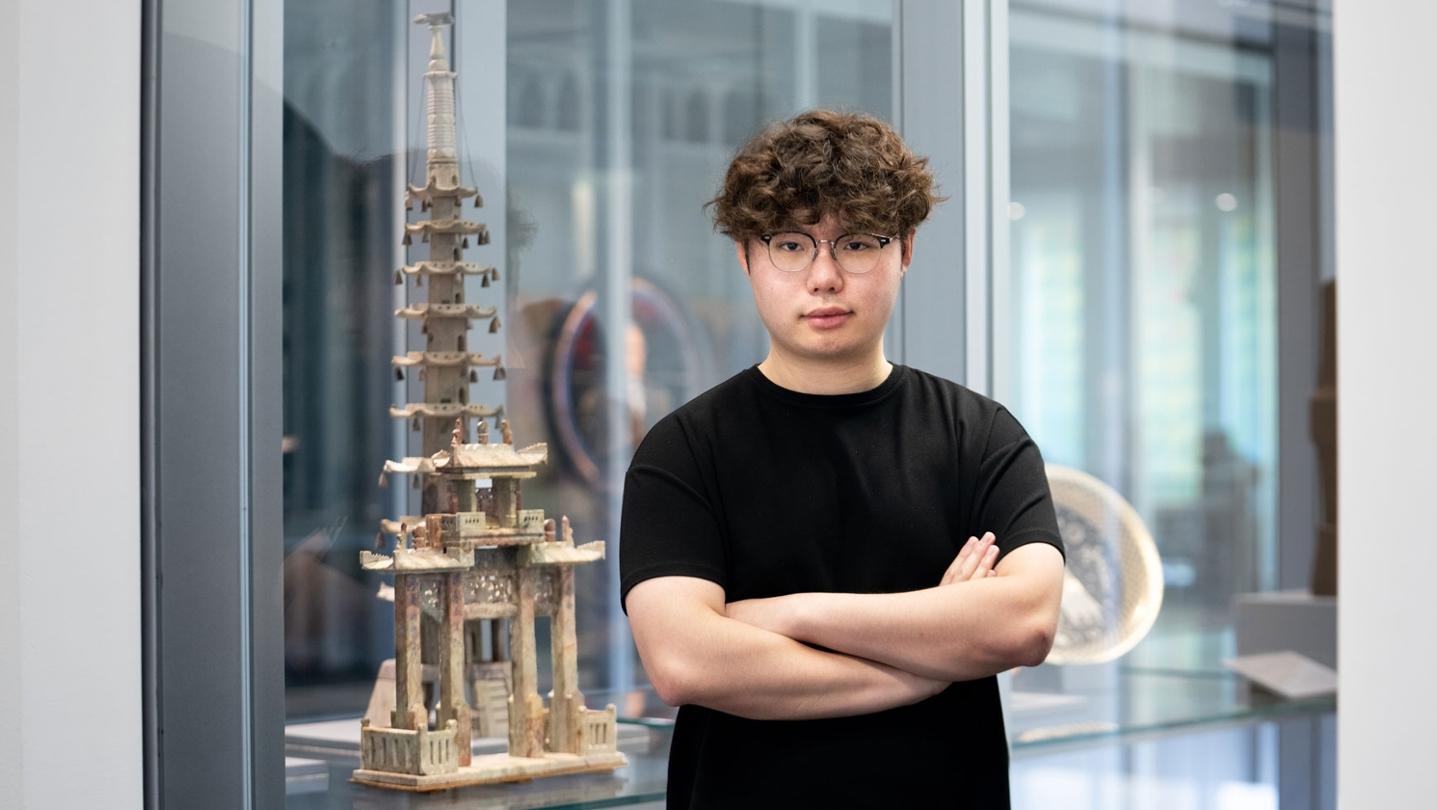
“I spent some time looking closely at the Chinese characters on the gate [and discovered] only the two middle lines are actually from a real classical poem. The other two lines do not form coherent classical Chinese text; they’re there because they look like they belong on a traditional Chinese gate,” Zhu said. “On an actual honorary gate, all four lines would form a complete, meaningful inscription. So this mix-and-match text suggests that this was probably made as a souvenir for foreign visitors rather than as a real architectural model.”
Zhu suspects that the models were likely made for the export or souvenir market. Soapstone is abundant in Fujian, and many local workshops in the mid-to-late 19th century produced small architectural models for visiting foreigners, officials, and merchants.
Despite the “errors,” Zhu finds the paifang valuable both aesthetically and historically. And he says it was fun to have had the opportunity to decode it after nearly 150 years.
“These objects don’t just tell us about China; they tell us about Hamilton’s 19th-century relationship with China through a returning missionary,” Zhu said. “Missionary collecting played a major role in shaping American museums’ early Chinese collections.”
| Chinese Inscription | English Translation | Chris Zhu’s Explanation |
|---|---|---|
![Chinese inscription: [Possibly:] He/You are a talented person from Luoyang.](/assets/mmlibrary/images/0x/talentedperson.jpg) |
[Possibly:] “He/You are a talented person from Luoyang.” | This phrase is grammatically unclear and does not sound like a standard line from classical Chinese poetry. It seems to imitate the language of literary talent and elite culture, but it feels fragmentary and decorative rather than part of a meaningful poem or formal inscription. |
![Chinese inscription: [Possibly:] He/You are a talented person from Luoyang.](/assets/mmlibrary/images/0x/clearsprings.jpg) |
Clear springs flow over the stones. | This is part of a famous line from Wang Wei’s Tang-dynasty poem “Autumn Evening in the Mountains.” It is a poetic landscape image often used for decorative purposes. |
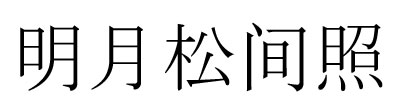 |
The bright moon shines among the pine trees. | This is also from Wei’s original poem. Its use here suggests a general classical Chinese style rather than a specific historical dedication. |
 |
Honored as a guest or official at the Golden Horse Gate. | “Golden Horse Gate” gives the phrase an ancient, official- sounding tone, but the line does not read like a coherent traditional Chinese poem. Instead, it feels like a decorative phrase that uses classical-looking words to suggest prestige. |
Material for this article was obtained from College Archives, editions of the Hamilton Alumni Review, and On the Hill: A Bicentennial History of Hamilton College by Maurice Isserman.
Related Stories
The Fascinating Life of Gerrit Smith
Gerrit Smith, Class of 1812, was valedictorian of Hamilton’s fifth graduating class. Born on March 6, 1797, he was one of the nation’s richest men — and one of the most radical, uncompromising, unforgiving, and hard-nosed leaders of American’s movement to abolish slavery. Here are a dozen facts about one of Hamilton’s most inspiring and influential alumni.
Cleveland claimed White House but not Hamilton degree
Grover Cleveland was the 22nd and 24th president of the United States. That was unique, as was his marriage in the White House at age 49 to his ward, Frances Folsom, a recent Wells College graduate. But why is any of this of interest to readers of the Alumni Review? The relevance is that young Grover planned to enroll at the college on the hill in Clinton, N.Y., where his family had lived. His older brother and mentor, William, graduated from Hamilton in 1851. But family finances and the death of his father precluded the president-to-be from enrolling.
