The Hill in History
-
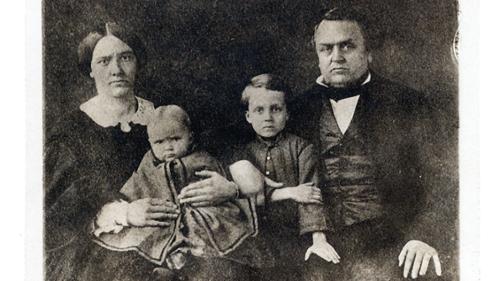
Justus Doolittle, Class of 1846, was among the first American Protestant missionaries to build cultural and educational connections between the United States and China. His legacy not only represents Hamilton’s broader historical contributions to global scholarship and intercultural exchange, but also continues to inform research and inquiry on campus today.
Topic -

Hamilton’s last major curricular review came in 2000. As the campus community begins envisioning “Open Curriculum 2.0,” here’s a look at how the College’s academic program has developed over the past 200+ years.
Topic -

Hamilton is steeped in stories that history alone cannot explain. From a trio of floating sisters to a mystery mummy to spectral professors who never left campus, these ghostly tales linger like unanswered questions, suggesting that College Hill holds more secrets than it chooses to share.
Topic -

Gerrit Smith, Class of 1812, was valedictorian of Hamilton’s fifth graduating class. Born on March 6, 1797, he was one of the nation’s richest men — and one of the most radical, uncompromising, unforgiving, and hard-nosed leaders of American’s movement to abolish slavery. Here are a dozen facts about one of Hamilton’s most inspiring and influential alumni.
Topic -

Self-appointed “dean and docent” of the Hamilton cemetery, Fred Rogers says, "To pluck a blade of grass in the College cemetery is to pull a golden thread that leads deep into Hamilton history." Read about some of the cemetery’s inhabitants.
Topic -

Long before Ezra Pound made a name for himself through his poetry or political viewpoints, he strolled the paths of College Hill. His association with his alma mater, like his life in general, was riddled with controversy. Pound, Class of 1905, may rank just behind statesman Elihu Root, Class of 1864, on the list of Hamilton’s most prominent alumni. Still, after his graduation Pound returned only twice to campus, and on one of those visits he got into a shouting match.
Topic -

Grover Cleveland was the 22nd and 24th president of the United States. That was unique, as was his marriage in the White House at age 49 to his ward, Frances Folsom, a recent Wells College graduate. But why is any of this of interest to readers of the Alumni Review? The relevance is that young Grover planned to enroll at the college on the hill in Clinton, N.Y., where his family had lived. His older brother and mentor, William, graduated from Hamilton in 1851. But family finances and the death of his father precluded the president-to-be from enrolling.
Topic -

“The ornament of a house is the friends who frequent it.” Ralph Waldo Emerson penned those words in his 1870 essay “Domestic Life,” and for more than 80 years they have stood as an apt and telling description of the Hamilton landmark that bears his name. Now, with the dedication of the Sadove Student Center at Emerson Hall during Fallcoming Weekend '10, the communal spirit invoked by the philosopher and poet resonates anew.
Topic -

The Hamilton-Oneida Academy began as an experiment in interracial education, which proved an abject failure. Its successor institution, Hamilton College, made no claims to interracialism and indeed was a largely white institution throughout its first century of existence. The College enrolled only a single African-American student, Joseph Spurlarke, Class of 1889, in the years between its founding and the conclusion of the First World War.
Topic
