Publications
-

American Communal Societies Series, no. 20, 136 pages, 2026
ISBN: 978-1-937370-46-6 ($25)
During the late nineteenth century an intentional community known as the God House took shape in the heart of Detroit. It began as an Jezreelite sect but adopted suspect tenets causing the group to splinter and run afoul of the law. Even with their criminal backgrounds, Michael Mills and Eliza Court maintained control during decades of turmoil and controversy. The God House story also intersects with other new religious movements such as the House of David and the Panacea Society. This historical examination attempts to understand the longevity and impact of this commune which stretched from the U.S., to Canada, and to England.
Julieanna Frost has been a writer and educator for over twenty-five years. She currently teaches at Northwestern Michigan College. Her main research areas include Women’s History, Religious Studies, and American Culture. She received her PhD from the Union Institute and University in 2007 with a specialization in Women’s History. She is the author of several books and scholarly publications, including one published previously by the Couper Press, The Worthy Virgins: Mary Purnell and her City of David.
-
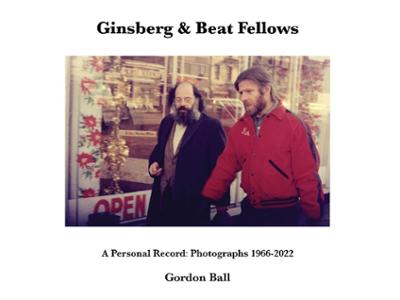
256 pages, full color, 2026.
ISBN: 978-1-937370-45-9 ($40)Over the course of sixty years, this gathering of image and information across sites as various as New York’s Lower East Side, San Francisco’s North Beach, Allen Ginsberg’s farm near Cherry Valley, New York; Boulder, Colorado and Lexington, Virginia (Naropa Institute and the Virginia Military Institute); as well as Jackson, Mississippi and Tokyo, features unique photographs of America’s celebrated poet in the company of “sacred companions” including Peter Orlovsky, William S. Burroughs, Herbert Huncke, Carl Solomon, Gregory Corso, Anne Waldman, Stan Brakhage, Jonas Mekas, Lawrence Ferlinghetti, and many others. Within its pages artist Robert LaVigne, who introduced Peter and Allen in 1954, serves the poet oatmeal and raisins for breakfast forty years later; Ginsberg and fellow Russian poet Andrei Voznesensky “conspire” together just ten feet from police; Shig Murao, who went to jail for selling Howl, welcomes visitors behind the register at City Lights; photographer Allen Ginsberg shoots rock star Lee Ranaldo reading from Jack Kerouac’s On the Road. The historical and aesthetic value of this treasure of personality and imagination across time and space is immense.
Gordon Ball edited Allen Verbatim and two volumes of journals with Allen Ginsberg. He began photographing the poet and colleagues during the three years he lived with them on Ginsberg’s upstate New York farm. He’s the author of three memoirs (’66 Frames, Dark Music, and East Hill Farm), a volume of short stories, On Tokyo’s Edge; and the tribute-memoir My San Francisco. His films and photographs have been shown and acclaimed widely. In addition to a Fulbright Specialist Lectureship at three universities in Tokyo, he taught at Old Dominion University, Tougaloo College, the Virginia Military Institute, and Washington and Lee University, before retiring several years ago. He lives with his wife Kathleen outside Lexington, Virginia.
Topic -

Shaker Studies, no. 20. 229 pages, 2026.
ISBN: 978-1-937370-44-2 ($45)In the small New England town of Harvard, Massachusetts, some thirty miles from Boston, there grew a small but significant Shaker society that thrived between 1781 and 1918. Planted by Mother Ann Lee herself, this communal society established four farms in the northeastern part of Harvard and in neighboring Ayer and Littleton. Their membership in the nineteenth century grew to as many as 180 Believers living and working in over eighty buildings on more than three thousand acres. Despite scant water resources, and poor-quality crop lands, their creative management of these, along with plentiful timber, left behind not only eleven surviving buildings, but numerous signs on the landscape of their skill and perseverance. Ned Quist uses documentary evidence and the landscape itself to tell the story of this remarkable cultural landscape the Harvard Shakers left behind.
Ned Quist is a retired academic librarian, having spent his career as a music librarian and library administrator at the Peabody Institute of the Johns Hopkins University and Brown University. In addition to his interest in Shaker studies, he builds reproduction Shaker- and Arts and Crafts-style furniture in his basement in Warwick, Rhode Island.
Topic -
One year subscription to the American Communal Societies Quarterly
-
Two year subscription to the American Communal Societies Quarterly
-
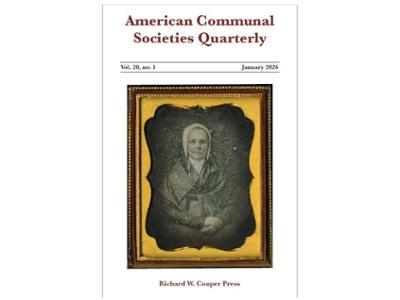
- Gift of Daguerreotype of Shaker Sister by David D. Newell
- “Tis pure pure brightness” – Considering an Early Shaker Daguerreotype by Carol Medlicott
- “Radicals” and “Libertines” in a Shaker Society: The Union Village Lyceum, 1871–1878. by Thomas Sakmyster
- Shaker Celibacy: A Cover for Sexual Scandal? by Richard Marshall
Front cover illustration: William North, Unidentified Shaker sister (possibly Betsy Bates?), ca. 1852, Cleveland, Ohio. Gift of Marcy Hermansader, in memory of Jonathan Flaccus.
-

American Communal Societies Series, no. 19. 256 pages, 2025.
ISBN: 978-1-937370-43-5 ($40)In response to the trauma of industrialization and urbanization in the late-nineteenth century, the Arts and Crafts Movement took America by storm. Art exhibits, workshops, and societies dedicated to handicraft, worker dignity, and the production of beautiful art for the masses sprouted from California to Boston. Ralph Radcliffe Whitehead, Elbert Hubbard, and William Lightfoot Price were so enamored with the movement that they decided to build entirely new worlds—intentional communities—dedicated to pursuing those ideals. Englishman Whitehead founded an art colony named Byrdcliffe in New York’s Catskill Mountains. Hubbard, a former soap salesman, established an Arts and Crafts community business, Roycroft, outside Buffalo, New York. Price, an architect, built the Rose Valley Association outside Philadelphia. They endeavored to reform the economic and social inequalities of industrial capitalism through communal living, artistic development, craft, and the sale of finely crafted furniture, architecture, metalwork, and more. This was what they believed was living “the art that is life.” For these community members, this meant producing and selling art with a social message as well as living everyday life as if it was a work of art. In imagining a compromise between machine-dominated industry and handicraft, these artisans sought to critique industrial capitalism and carve out a space where craftspeople could once again flourish in community. Rose Valley, Byrdcliffe, and Roycroft were total sensory installations of the Arts and Crafts Movement that stood as community-workshops that were an alternative to brutal industrialization.
Thomas A. Guiler (Ph.D., Syracuse University) is the director of museum affairs at the Oneida Community Mansion House in Oneida, New York. He was assistant professor of history and public humanities at the Winterthur Museum, Garden & Library in Wilmington, Delaware. He also served at the president of the Communal Studies Association. He has published on the history and material culture of intentional communities such as Oneida and of the Arts and Crafts Movement.
-
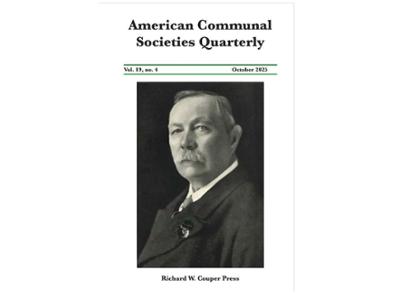
- “You are to do what we say”: The Adventures of Arthur Conan Doyle and His Spirit Guide Pheneas, Michael W. Homer
- “I am all sympathy with Theosophy”: Arthur Conan Doyle’s Final Conversion, Michael W. Homer
Front cover illustration: Arthur Conan Doyle (1859–1930) taken in 1923.
Back cover illustration: A photo of the Cottingley Fairies that appeared in
The Coming of the Fairies, 1921. -
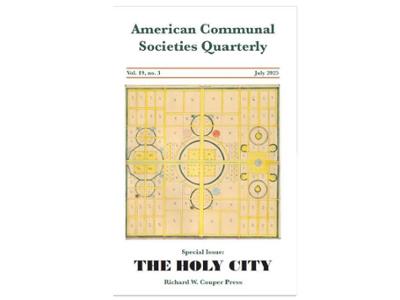
- From the Editor
- New Light on the Holy City
- "Explanation of the Holy City," 1843
Front cover illustration: Anonymous, The Holy City, 1843 (detail). Gift of Mr. and Mrs. Julius Zieget, 1963. Accession no. 1963-160-5. Philadelphia Museum of Art.
Back cover illustration: Fountain stone, Shirley, Massachusetts, late-nineteenth century. Photograph. Communal Societies Collection, Hamilton College.
-

- From the Editor
- The Gospel of Thomas Hammond
- A Reconsideration of the Neal(e) Family
- “Blanche to Church all alone”: Canterbury’s Evolving Religious Praxis
Front cover illustration: The Qui Vive Quartette (sisters Jennie Fish, Jessie Evans, Josephine Wilson, and Helena Sarle) often performed at venues across the region.
Courtesy of Canterbury Shaker Village.
Back cover illustration: Frederick Demont visiting his aunts at the Ann Lee Cottage, c. 1938. Seated: Sarah Neale, Emma Neale, Ethel May Demont Peterson holding Douglas Lee Peterson, Neale Lawrence Peterson. Courtesy of Canterbury Shaker Village.
